
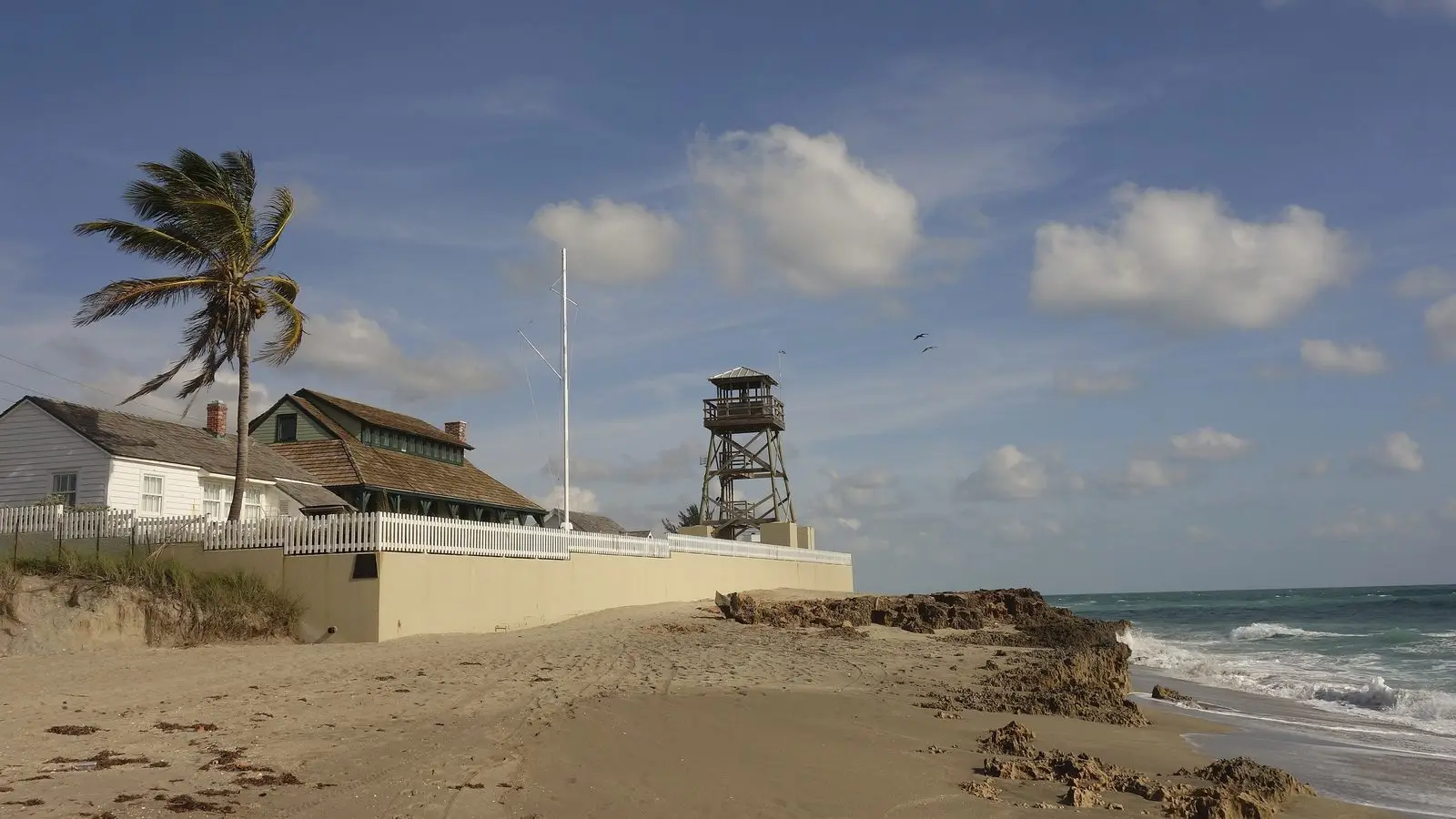
In the 1870s the east coast of Florida between St. Augustine and Biscayne Bay was two hundred miles of beach with almost nobody on it, and the Gulf Stream ran so close that ships wrecked on it every year. The sailors who reached the sand often died there anyway, of thirst and exposure, days from the nearest house. In 1876 the United States Life-Saving Service built ten houses of refuge along that coast, twenty-five miles apart, and put a keeper and his family in each.
What a keeper did
The job was not to row out to wrecks, as the lifesaving crews did up north; there were no crews, only one man. The keeper walked the beach after every storm looking for survivors, brought them to the house, fed them from the stores and kept them until a boat could take them off. Between storms he kept a ledger, raised chickens and children, and watched the horizon. The house at Gilbert’s Bar logged its first rescue in 1886 and its most famous in 1904, when the Georges Valentine wrecked on the rocks a few hundred yards south and the keeper brought five men ashore in the dark.
The one that is left
Nine of the ten houses are gone, to storms, fire and development. The House of Refuge at Gilbert’s Bar stands where it was built, the oldest building in the county, with its porch over the rock and its boathouse of surfboats, and the Second World War watchtower beside it from the years when the Coast Guard watched for German submarines from the same spot. It is a museum now, and a good one.
- Open daily; Sunday from 1 pm.
- The ledger of wrecks is on the keeper’s desk.
- Walk the rock below the house at low tide; it is the same reef that makes Bathtub Beach.
- The lantern tour in winter is the way to see it as the sailors did.
There is a plaque for the Georges Valentine on the beach to the south, where the rocks are, and on a rough day you can stand there and understand the whole idea.